Posts Tagged ‘Delhi College’
January 17, 2011 in 1857,Delhi Heritage Walks,DHW,Heritage Walks,Kashmiri Gate,Kashmiri Gate Heritage Walks | Comments (0)
Delhi was the centre of the Uprising of 1857. As a result, the area around the Mughal capital of Shahjahanabad is full of landmarks of the revolt. This heritage walk beings at Nicholson’s Cemetery, named after the British general who was fatally wounded fighting the rebels. His grave lies in the cemetery. The cemetery has several contemporary graves, one of the most prominent being that of Master Ramachandra, of Delhi College fame. The trail then continues into the fortified area of the former capital of Delhi. The Kashmiri Gate stands testimony to the battles of 1857. It is the point from where the Indian rebels stood to defend themselves from the British siege. The breaking of the defenses at Kashmiri Gate, turned the tide in British favour and they soon overtook the city of Delhi. Before 1857, the neighbourhood around here had residences of prominent officials of East India Company. Some traces of these still remain. Walking through the market here, one can see the Lal Masjid also known as the Fakhrul Masajid and the old Hindu College & old St. Stephen’s College buildings. St. James Church, the oldest church in Delhi, stands tall, across the road. It was built by James Skinner, in thanksgiving, when he survived wounds suffered in a battle. Continue Reading This Post
May 24, 2010 in 1857,Delhi Heritage Walks,DHW,Heritage Walks,Kashmiri Gate,Kashmiri Gate Heritage Walks | Comments (0)
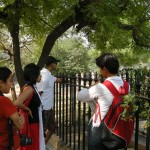
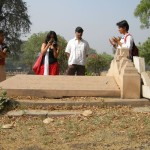
Braving the summer heat, a group of heritage enthusiasts got together to explore the landmarks of the revolt of 1857 in Delhi. We covered sites located in the neighbourhood of Kashmiri Gate which falls within the old city, the former Mughal capital of Shahjahanabad. The starting point was Nicholson’s cemetery, named after Brigadier General John Nicholson who died fighting the rebels in 1857. He was fatally shot during the storming of Lahori gate, during recapture of Delhi by the British in September 1857. Another important person who is buried here is Master Ramachandra, professor of Mathematics in the then Delhi College. Across the road from Nicholson’s cemetery are remains of the city walls and the Kashmiri gate. The road roughly marks the demarcation between rebels inside the city and where the British were camped on the Ridge. The Kashmiri gate is one of the four surviving gates of the boundary of Shahjahanabad. The others which still stand are Ajmeri gate, Turkman gate & Dilli gate. Kashmiri gate still bears the damaged done to it by the British cannons while storming the city. There is also a memorial to the dead of the British army at this gate. Continue Reading This Post
April 27, 2010 in 1857,Delhi Heritage Walks,DHW,Heritage Walks,Kashmiri Gate,Kashmiri Gate Heritage Walks | Comments (1)
This heritage walk covers the modern neighbourhood of Kashmiri Gate near the ISBT. Most of the sites here relate to first half of 18th century and some specific events associated with the revolt of 1857. In the 17th century this area was part of the Mughal capital of Shahjahanabad, what is today old Delhi. Kashmiri gate has mansions of some important personalities associated with the Mughal court like, Ali Mardan Khan, the noble who was instrumental in building canals which brought water to the city and Dara Shukoh, Shahjahan’s son. Later, the British started living in this neighbourhood. It is their buildings which mostly survive now.
We started the heritage walk from Nicholson’s cemetery. John Nicholson was a British general, instrumental in breaching the defenses of rebels who were controlling Delhi, and in the process lost his life. The cemetery is named after him, but there are other important people buried here as well. Continue Reading This Post
« Newer Posts Older Posts »